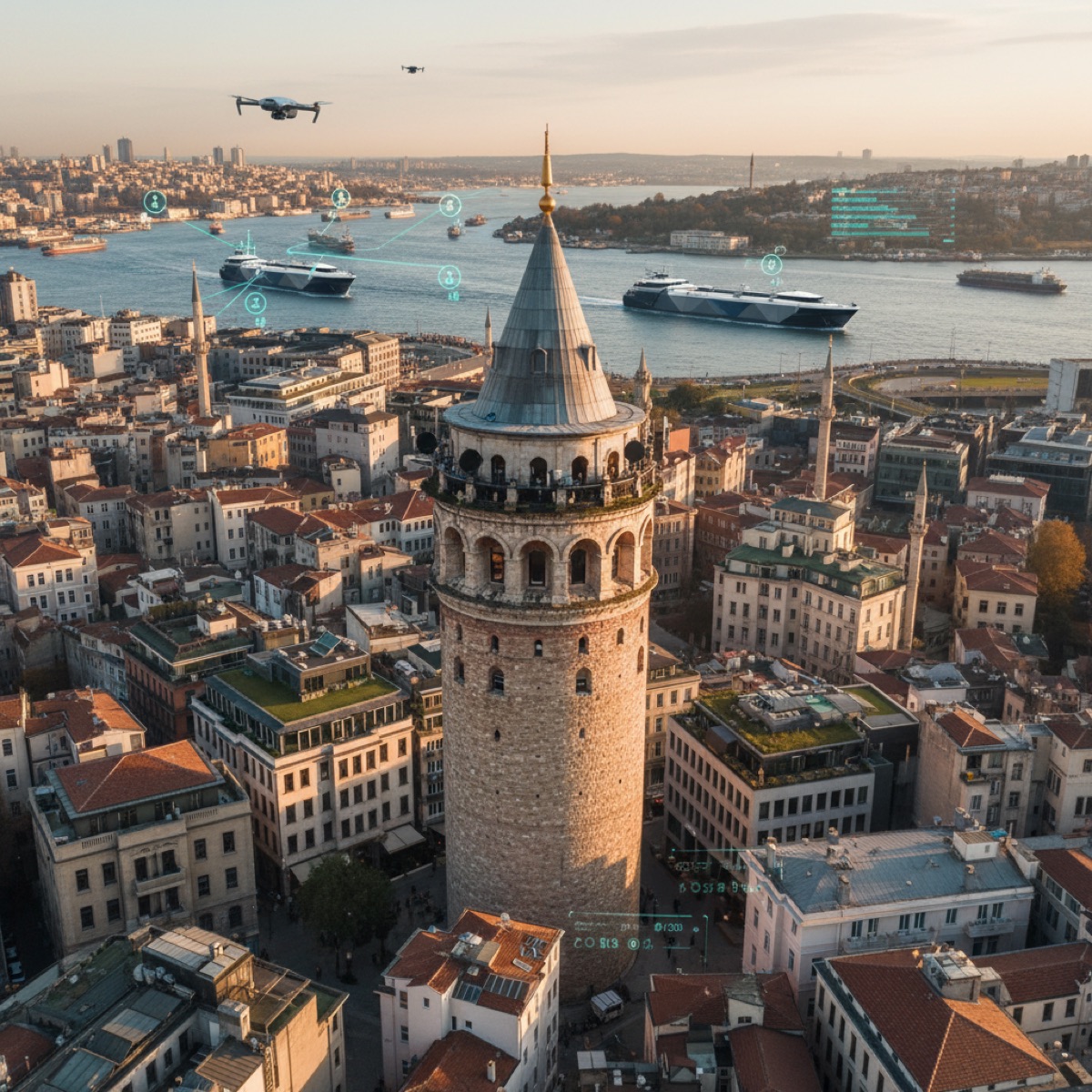
An indispensable part of Istanbul's ancient skyline, the Galata Tower has served many different purposes over the centuries. Delving into the historical depths of this iconic structure, we will examine in detail its critical role, especially in terms of Galata Tower Maritime Safety, and its current importance as of 2026. The Galata Tower stands out with its inseparable bond with seafaring from past to present, consistently contributing to Galata Tower Maritime Safety throughout history.
History of Galata Tower and Its First Maritime Observation Roles
The origins of the Galata Tower date back to the Byzantine period, more precisely to 507 AD. However, the structure we see today was rebuilt by the Genoese in 1348 under the name "Tower of Christ". During this period, the Genoese colony of Galata was an important trade center, and the tower was used as a strategic lookout point to protect the city from potential threats from the sea. Maritime activity, enemy ships, and weather conditions were closely monitored by observers in the tower, ensuring early forms of Galata Tower Maritime Safety.
Genoese Period and Trade Security
- For the Genoese, Galata Tower Maritime Safety was vital for the uninterrupted continuation of their commercial activities.
- The tower was in a strategic position controlling the entrance to the Bosphorus and the Golden Horn, crucial for Galata Tower Maritime Safety.
- Observers identified ships approaching the harbor and provided early warnings against potential dangers, enhancing Galata Tower Maritime Safety.
- During this period, the tower played a key role in ensuring the security of maritime trade routes.
With the conquest of Istanbul by the Ottoman Empire, the functions of the Galata Tower also began to change. However, its connection with the sea was never severed; on the contrary, it gained a different dimension, continuing its legacy in Galata Tower Maritime Safety.
Galata Tower During the Ottoman Period and Fire Surveillance
After the conquest, the Galata Tower was used for many years as a dungeon, an observatory, and most importantly, a fire lookout tower. Especially due to the frequent fires in Istanbul, officials in the tower would monitor all corners of the city and provide a critical public service by warning the public when they detected fires. In this role, albeit indirectly, it also played an important role in protecting ships in the harbor and structures along the coastline from the danger of fire, contributing to overall Galata Tower Maritime Safety.
Fire Surveillance and Its Impact on Maritime Trade
Fires were a great threat not only to land settlements but also to ships anchored in harbors and stored goods. Galata Tower Maritime Safety ensured the sustainability of maritime activities and the safety of commercial goods by preventing the spread of fires to the harbor and its surroundings. Lookout towers allowed necessary teams to intervene quickly in case of fire, bolstering Galata Tower Maritime Safety.
- Fires threatening the city also negatively affected ships in the harbor and the security of trade, making Galata Tower Maritime Safety crucial.
- Fire watchers in the tower were also on alert for possible fires in seaside warehouses and on ships.
- Thanks to early warning systems, fires could be brought under control before they grew, minimizing disruptions in maritime trade and enhancing Galata Tower Maritime Safety.
Galata Tower: A Seismic Observation Point and Unknown Uses
The Galata Tower was used not only for marine surveillance or fire detection but also for scientific purposes. Especially in the 16th century, an observatory founded by Taqi al-Din operated here. This observatory made important contributions to the science and geography of the period, as well as to astronomical observations. The study of stars and celestial bodies, which are critical for navigation and seafaring, was part of the scientific studies carried out in the tower, indirectly supporting Galata Tower Maritime Safety through improved navigation.
Hezarfen Ahmed Çelebi and the First Flight Attempt Over the Sea
One of the most famous legends of the Galata Tower is the rumor that Hezarfen Ahmed Çelebi flew from here to Üsküdar by attaching wings. This event, said to have taken place in the 17th century, has symbolic importance in Turkish aviation history. Hezarfen's glide over the sea further strengthened the mystical bond between the tower and the sea. Although this historical moment offers a different perspective from the Galata Tower Maritime Safety concept, it shows the tower's role in humanity's quest to push boundaries.
- The tower represented a suitable high ground for scientific observations.
- Astronomical observations were indirectly important for navigation and mapping in seafaring, contributing to Galata Tower Maritime Safety.
- Hezarfen's flight attempt shows that the tower was used not only as an observation point but also as a starting point.
Galata Tower and Istanbul Ports Current Status in 2026
As we reach 2026 today, the function of the Galata Tower has completely changed, but it continues to be a symbol that emphasizes Istanbul's connection with the sea and the city's global importance. The tower is no longer a lookout point, but rather a cultural heritage site that welcomes millions of tourists and a unique viewing terrace. Learn more about the Galata Tower's role in environmental observation in 2026. However, Istanbul Ports, along with the maritime traffic in the Bosphorus, one of the world's busiest waterways, continue to require intensive security and management in 2026, building upon the historical legacy of Galata Tower Maritime Safety.
Modern Solutions and Future-Oriented Approaches for Maritime Safety
Today, maritime security in the Istanbul Bosphorus is provided by modern technologies. Advanced technologies such as radar systems, satellite tracking, automatic identification systems (AIS), and unmanned aerial vehicles monitor maritime traffic instantly and provide rapid intervention capabilities against potential risks. Navigation safety in the Bosphorus and port areas is meticulously ensured by the Ministry of Transport and coast guard units. These modern systems, which have taken over the duty of the Galata Tower, constitute the contemporary interpretation of the Galata Tower Maritime Safety concept.
- Maritime traffic in the Istanbul Bosphorus and ports is monitored 24 hours a day with high-tech systems. The Turkish Ministry of Transport and Infrastructure provides continuous updates on maritime safety regulations and initiatives in 2026, ensuring modern Galata Tower Maritime Safety.
- Rapid intervention teams are on standby for possible maritime accidents, illegal crossings, or other security breaches, upholding the principles of Galata Tower Maritime Safety. Interested in historical defense structures? Read about Galata Tower's connection to Istanbul's ancient walls and gates.
- Environmental protection, prevention of oil spills, and combating marine pollution are also important security agenda items for comprehensive Galata Tower Maritime Safety. Explore how the Galata Tower serves as a global symbol for education and civilization.
- The historical mission of the Galata Tower is continued today with modern and integrated systems. Istanbul's commitment to urban preservation and protection of its historical sites is a key focus in 2026, as highlighted by initiatives from the Turkish General Directorate of Cultural Heritage and Museums, reflecting the enduring spirit of Galata Tower Maritime Safety.
While the Galata Tower was once a lookout point providing Istanbul's Galata Tower Maritime Safety, today it stands as a structure that still carries the spirit of this historical heritage, but with a different mission. The old marine observation tower now continues its existence as a historical monument and an attraction center offering visitors of Istanbul a magnificent city view. In 2026, the Galata Tower will continue to maintain its importance both as a symbol bearing the traces of the past and as a part of Istanbul's dynamic identity, forever linked to the concept of Galata Tower Maritime Safety.